The following is copied from the NCCA ON THE THE NEW PRIMARY CURRICULUM
Introduction
As a parent you are the most important person in your child’s life. You help them learn many important things and as your child moves through primary school, your ongoing help and encouragement make a big difference in their learning journey.
What is the Primary School Curriculum?
The Primary School Curriculum outlines what children should learn and how children learn through the four stages of primary school, as appropriate to their needs, interests and abilities.
The curriculum aims to:
provide a strong foundation for every child to thrive and flourish
support every child in realising their full potential.
The curriculum views each child as unique, competent and caring. It recognises that every child has the right to keep learning and developing as they grow. There are eight principles that show what is most important in your child’s education. They guide how children learn, how teachers teach and how progress is assessed.
Principle
What does this mean for your child?
Learning
Environments
Children are supported in their learning across a variety of environments, both indoors and outdoors.
Inclusive Education and Diversity
Children are welcome at school and have opportunities to learn in ways that suit their individual learning needs, interests and abilities. Similarities and differences are celebrated making sure every child feels respected and included in their classroom and school.
Engagement and
Participation
Children make choices as part of their learning. They have opportunities to be creative and to work with others.
Assessment and
Progression
Children, teachers, parents and sometimes other relevant professionals (for example, speech therapists, psychologists) work together to help understand how children are learning and developing and how they can make progress.
The Primary School Curriculum also includes seven key competencies for children. The competencies describe the knowledge, skills and attitudes that support children in their learning and development. They recognise that children grow, learn and develop important life skills through everything they do at school – whether it’s by being part of playful and engaging lessons, interacting with others or experiencing the daily routines.
Key competency
What does this mean for your child?
Being an active citizen
Understanding the rights and responsibilities of themselves and others and how to take positive actions to create a more sustainable and just world.
Being an active learner
Playing, learning and working on their own, and with others, to reflect on their learning, to solve problems and to set goals for future learning.
Being a communicator and using language
Learning to share ideas in different ways, and to listen and respect what others share.
Being creative
Being curious about, taking part in, and enjoying creative and imaginative experiences.
Being a digital learner
Using a variety of digital technologies creatively and learning to be responsible and safe online.
Being mathematical
Seeing maths in the world around them and using maths to solve problems and make sense of the world.
Being well
Supporting them to be healthy and developing their physical, social, emotional and spiritual wellbeing.
What does my childlearn in school?
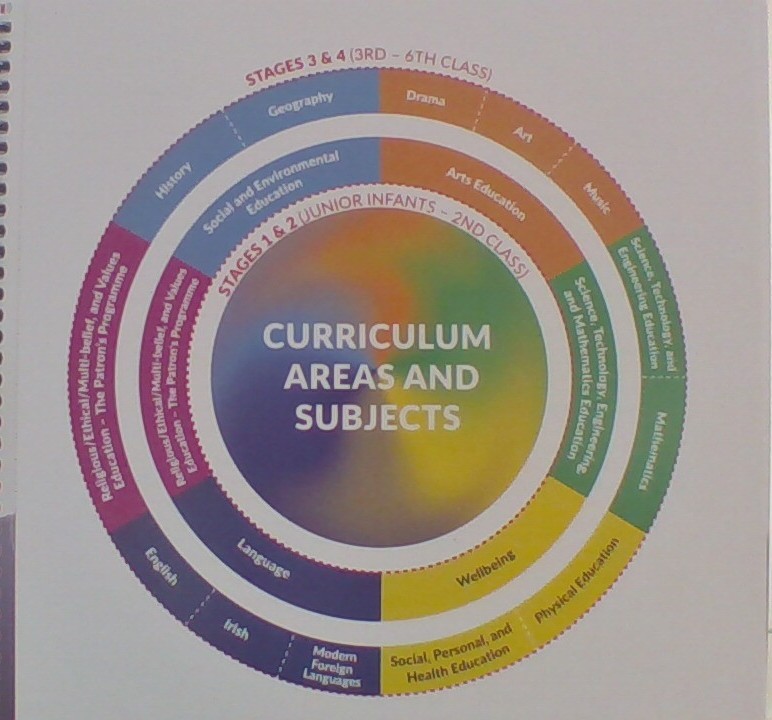
Children’s learning is organised across curriculum areas and subjects including:
Language (English and Irish with Modern Foreign Languages introduced in Stage 3 and 4)
Science, Technology, Engineering and Mathematics (STEM) Education
Wellbeing (Physical Education [PE] and Social, Personal and Health Education [SPHE])
Arts Education (Art, Drama and Music)
Social and Environmental Education (Geography and History).
Curriculum areas and subjects
In stages 1 and 2 (Junior Infants to Second Class), children learn through broad curriculum areas. This helps children connect their learning to everyday life and gives the teacher flexibility to create engaging experiences linked to different topics and subjects.
In stages 3 and 4 (Third to Sixth Class), as children move through the primary classes, these broad curriculum areas become organised into more specific subjects to reflect their growing awareness of subjects as a way of organising the world around them.
Children with special educational needs (SEN) will engage with the different curriculum areas, subjects and stages as appropriate to their needs, interests and abilities.
In addition, the Patron’s Programme is developed by a school’s patron with the aim of contributing to children’s holistic development, particularly from the religious and/or ethical perspective, and underpins and supports the characteristic spirit of the school.
Literacy Initiatives
Our school is involved in many literacy initiatives to supplement the work of each class curriculum. These include:
• Team Teaching
• Literacy Power Hour
• Visits to Local Library
• Paired reading
• Shared reading
• World Book Day
Numeracy Initiatives
Our school has purchased a lot of Maths resources and equipment to enable pupils to have a practical and hands on experience in Maths. Maths initiatives include:
• Maths Week
• Maths Workshops
• Shared Teaching
• Maths Trails
An Ghaeilge
Tá sé mar aidhm againn atmasféar Gaelach agus dearcadh dearfach a chothú sa scoil. Mar sin, bainimíd usáid as nathanna cainte sa seomra ranga agus sa chlós go minic.
We wish to promote an Irish atmosphere and a positive attitude to Irish in our school. Irish phrases and sentences are often used in the classroom and schoolyard.
Religious Education
The “Grow in Love” curriculum is implemented in the Infant Classes. We have regular visits to our school from our local priests.
Science
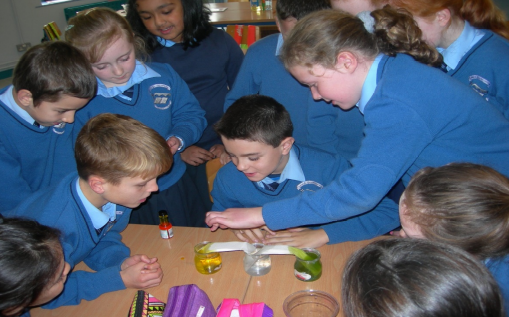
Science week is marked in our school each year. This year various science experiments were carried out by the pupils of 6th class for the whole school to enjoy. The experiments ranged from a feast of dancing raisins to volatile volcanos, enabling pupils to become more aware of the fascinating world of science. 5th & 6th Class enjoyed Science Workshops.
Art
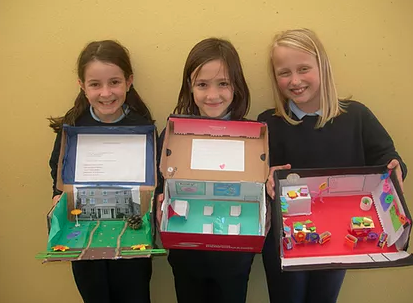
Art is very strong in our school. The notice boards outside each classroom are awash with beautiful art work prepared by the pupils. Each year pupils partake in a variety of art competitions including the local Credit Union Art Competition.
Assessment
The Curriculum identifies assessment a being integral to all areas of the curriculum. It helps communication between the progress between the teacher and the child, the teacher and parents and teacher and teacher. It enables the child to become increasingly self-aware as learner and to development techniques of self-assessment. It is essential to ensure that an ongoing high stand of education is maintained. In Cappoquin Primary School, assessment ranges from informal assessment which includes teacher observation, classwork, and homework, to more formal assessment in the form of teacher designed tests, diagnostic tests and standardised tests. All pupils from First to Sixth Form are given standardised tests in English and Mathematics every May. Assessment is used to identify children with specific learning difficulties so that the appropriate steps can be taken to ensure progress is achieved despite difficulties which exist. In addition to traditional assessment of knowledge, pupils are also assessed on their acquisition of skills, attitudes and values.
From Junior Infants upwards, parents receive summer reports. Parent/ teacher meetings are usually held each November.